
Former Names for Lowestoft Streets, Roads and Scores
Former Names for Lowestoft Streets, Roads and Scores
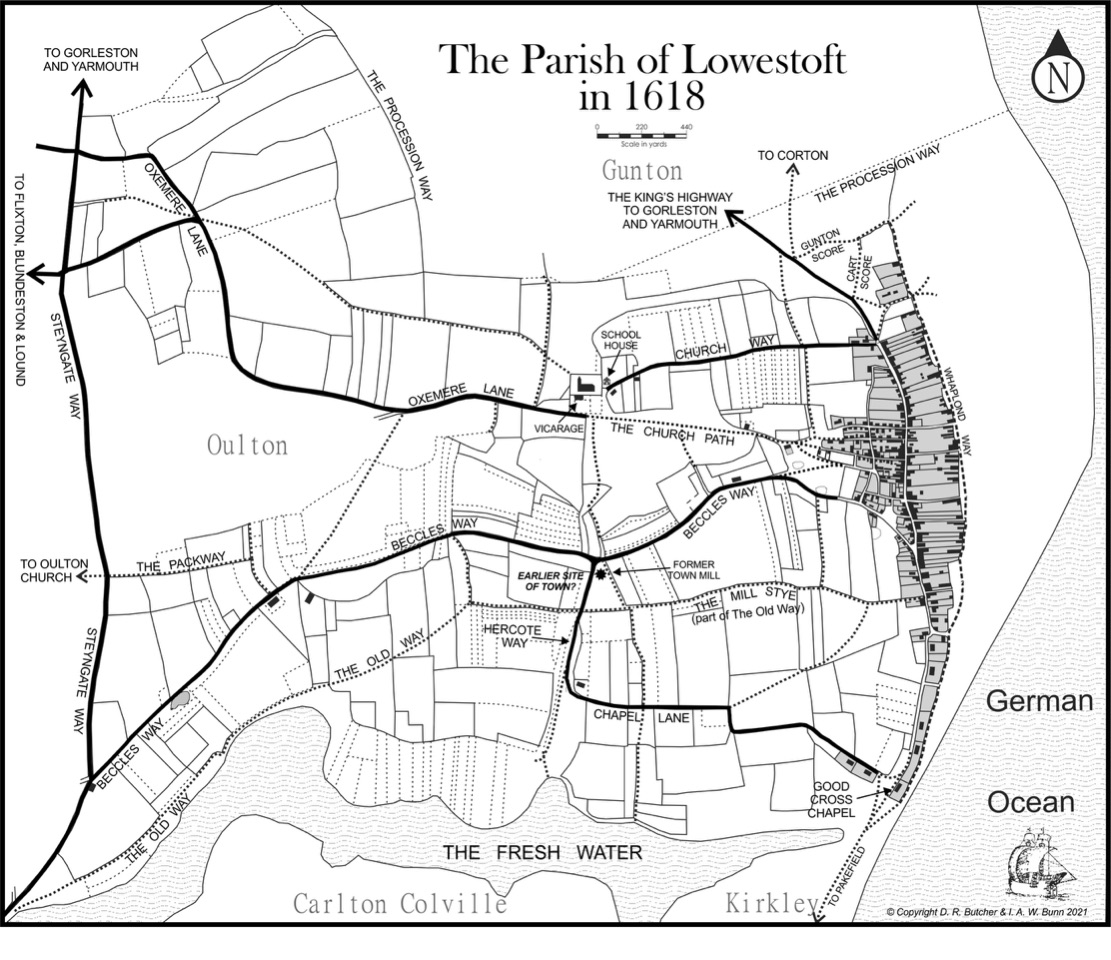
All of the older names listed below in italic font derive from documentation of one kind or another relating to the town – particularly those manorial records recording the transfer of property 1582-5 & 1616-1756, to the Revd. John Tanner’s transcriptions of these done up until 1720-25, and to the Manor Roll of 1618. All found as Suffolk Archives (Ipswich), 194/A10/4, 194/A10/ 5-19, 454/2 and 194/A10/73.
Taken together, these particular sources are able to show something of the Lowestoft community’s nature over a time-span of about 500 years (c. 1300-1800). The mid-19th century saw rapid expansion of the town in terms of population and house-building, following the construction and expansion of the harbour and the provision of railway links with Norwich and Ipswich.
The earlier structure of the parish as a whole, and of the Late Medieval-Early Modern township, is still able to be interpreted lying beneath the bricks, concrete and asphalt placed upon them during the 19th and 20th century. It is simply a matter of looking for it with the help of the surviving documentation available and applying what is found to the topography and urban layout of today.
1. Battery Green Road: High Street (South End). It is clear from the Manor Roll of 1618 (Suffolk Archives, Ipswich, 194/A10/73) that this stretch of highway was a considered to be a continuation of the High Street beyond the part now constituting Old Nelson Street – accommodating six houses strung out along it on large plots, on the west side of the roadway, and ending at the Good Cross Chapel which had undergone conversion to domestic use probably during the middle of the 16th century. A hundred years later, c. 1720, the number of dwellings had increased to eight. The Battery association in the renaming came about as a result of a major gun emplacement being built during 1782 (in the area formerly occupied by the former multi-storey car park). It housed ten 32-pounder and three 18-pounder guns and had (in its north-western angle) a bomb-proof underground magazine capable of storing 300 kegs of gunpowder. The guard-house stood in the middle of the complex, with a parade-ground fronting it, and the whole structure was ditched and banked about (with drawbridge entry), with a wide glacis sloping to the sea. All of this information is to be found in Edmund Gillingwater’s An Historical Account of the Ancient Town of Lowestoft (1790), p. 427.
2. Bevan Street East & West: Chapel Lane. This was named after the Late Medieval wayside chapel which stood in the vicinity of today’s Fish Market entrance and (with the Norwich Road section) served as the route to it from the original township site, located somewhere in the north-eastern sector of what is now Normanston Cemetery. Suffolk Road (as it now is) completed the footway. The Chapel’s main attraction and object of devotion was a claimed piece of the cross on which Christ was crucified. The presence of this footway gave access to the building, prior to the township moving onto a clifftop site during the first half of the 14th century.
3. Bridge Road: Beccles Way, Beccles Road. A very short stretch only, of this, in Lowestoft: left-hand side of the carriageway heading to Mutford Bridge and stopping just past Harbour Road (opposite Harrison Road). The rest of the way was situated in Oulton parish.
4. Camden Street: Flye’s Lane. This short stretch of road represents the turn to the east made by the much older Flye’s Lane, in order to link with the High Street (see No. 15 below). It now forms the final stretch of Jubilee Way, meeting up with the said High Street opposite the green space left open after post-World War Two demolition of bomb-damaged Nos. 5-25.
5. Cart Score: Gallows Score. There may well have been a gallows or gibbet-post standing at the top end of this score during the 14th and 15th century. Lowestoft was the hub of the Lothingland Half-hundred manor (as well as being a manor in its own right) and would have had power of execution as one of its privileges and its legal standing. An out-of-town location on the bleak North Common, close to the tracks which crossed it, would have been seen as a suitable location for such an instrument of capital punishment and public warning.
6. Church Road: The Church Path. Continuation of the most direct way to St. Margaret’s Church, after the township had moved from its earlier site onto the cliff during the first half of the 14th century. This footway carried on from Bier Lane across Church Green – a large expanse of common land, used mainly for grazing cattle.
7. Compass Street: Bier Lane, Tyler’s Lane. The former of these names dating from the 14th century, when the roadway formed part of the route to St. Margaret’s Church – along which the shrouded remains of dead townspeople were carried on a hand-bier for burial in St. Margaret’s churchyard. The later name was in use by the 17th century and was possibly the family surname of long-term residents.
8. Crown Score: George Rugge’s Score is the earliest recorded name found – the result of a man of that name having a shop of some kind, situated on its southern corner with the High Street, during the late 16th/early 17th century. It then became Ferney’s Score during the first half of the 17th century, when Thomas Ferney (cobbler) occupied the premises – to be changed again, after mid-century, to Lyon [ Lion] Score when it functioned as an inn of some kind named after that particular animal. A description of the property in 1720 describes it as a single house divided into separate dwellings, belonging to John Hayle (grocer) – which suggests that it may also have changed names to Crown Score by then.
9. Crown Street (East & West): Bell Lane, Crown Lane. These names are found in interchangeable use, deriving from The Bell and The Crown inns (Nos. 148-149A and No. 150 High Street) which stood either side of the roadway’s junction with the High Street. Bell Lane seems to have been the one more commonly used, which may indicate that The Bell was founded earlier than its neighbour. The bell reference may well have derived from the one which hung in the Town Chamber (site of the later Town Hall) and sounded the curfew at 8 p.m. each evening.
10. Dove Street: Bier Lane, Fair Lane, Almshouse Lane. These three names reflect varying uses and aspects of the Late Medieval/Early Modern town’s activities – the Bier Lane reference already having been dealt with above in No. 7. Fair Lane is connected directly with The Fairstead where the town’s annual fairs were held, this open area being occupied nowadays by St. Margaret’s Plain and the bottom ends of Park Road, Queen’s Road and Cambridge Road. The Almshouse connection is of later origins than this, when a line of eight small charitable dwellings once stood on the north side of the roadway (at its junction with West Lane).
11. Duke’s Head Street: Blue Anchor Lane. The origin of this name seems to have derived from an inn or alehouse of some kind, probably called The Blue Anchor, which stood on the north side of the roadway next to the plot(s) now numbered 134 & 135 High Street. The former Old Blue Anchor Stores public house (now the Old Blue Anchor seafood restaurant and bar), at No. 133A High Street, is likely to have been some kind of continuation of the name.
12. Fir Lane: Skamacre Lane. The earlier recorded name derived from the former Lowestoft area of common land (used mainly for the rough grazing of livestock during the Late Medieval and Early Modern periods), which was largely situated to the north of Beccles Way (Normanston Drive). This area of heathland – known as Skamacre Heath – stretched westwards into the parish of Oulton and was crossed by a south-west/north-east aligned track to link Beccles Way with Oxmere Lane (Oulton Road). The name Fir Lane is to be found on the OS 1:2500 scale map of 1885 (twenty-five inches to the mile) and may have resulted from the presence of conifers in this vicinity, as the map shows them growing in the grounds of Normanston Court (a large house situated at the top end of what was later to become Normanston Park) and those of two substantial dwellings on the north side of the main roadway just a little further on towards the central built-up area of Lowestoft.The other possibility is that “Fir” might possibility be a variant of furze – an old alternative word for “gorse”, a shrub which would have once grown profusely in the area.
13. Gorleston Road: Steyngate Way. A variation of Stonegate Way, indicating that this particular highway is part of a surviving Roman road system which ran from the Gariannonum shore-fort at Burgh Castle (built c. 260-80 AD/CE) to reach various destinations lying to the south of it. The first part of the name consists of Old Norse steinn (stone) and gata (road), while the second derives either from Old English weg or Old Norse vegr(journey). Such derivation clearly demonstrates the Scandinavian influence of the years 878-954, when East Anglia formed part of The Danelaw – created as a compromise partitioning of England, following the invasion by the so-called Great Heathen Army in the year 865. Half of Lothingland’s place-names (including Lowestoft) are wholly or partly Scandinavian.
14. Herring Fishery Score: Baryngforth’s Score is the earliest name found, this being the surname of a family of mariners who lived at the top of the score on its southern side during the late 16th and early 17th century. The Christian names of father and son being Ralph and William. How long this title remained in use is not known and the Revd. John Tanner’s 1720 listing of copyhold properties in the town (Suffolk Archives, Ipswich, 454/1) simply refers to it as a common score – thus indicating its use as a public footpath and right-of-way. Jack Rose’s Lowestoft (1981), p. 28, gives Christchurch, Porter’s, Nelson, Spendlove’s and Penloo’s[Penlow’s?] as names, but whether or not this is in time-sequence is not known. The use of apostrophe s would seem to indicate people’s surnames, while Nelson may have been to do with Old Nelson Street itself or with Thomas Huke’s Nelson Printing Works, which stood a few doors down from the score during the later part of the 19th century. Christchurch obviously derived from the name of the place-of-worship located at the bottom of the score (founded 1868), while Herring Fishery resulted from a former name of the public
house now known as The Carousel (No. 108 High Street). The name Spendlove’s Score itself is found used in a hand-drawn map of the High Street area’s southern sector, created by Robert Reeve (solicitor and steward of the manor) and following p. 197 of his unpublished ‘A History of Lowestoft and Lothingland’, vol. 4. (c. 1810) – Suffolk Archives (Ipswich), 193/3/4.
15. Jubilee Way: created by extensive widening of Back Lane/Chapel Lane, West Lane/White Horse Lane (one name following the other, in both cases) and Flye’s Lane
– carried out as the northern part of Lowestoft’s inner relief road during 1977. This old stretch of roadway, having three distinct names, ran parallel with the High Street. The first section began at Beccles Way (near 72 St. Peter’s Street) and ran as far as Webb’s Lane/ Frary’s Lane (Wesleyan Chapel Lane); the middle part stretched from there up to Swan Lane (Mariners Street); and the final leg ran to the rear of what are now Nos. 159-176 High Street – being named after a man called Robert Fly(e), who held an arable field to the west of the house-plots, known as Flye’s Close, during the first half of the 16th century. A name that continued in use well into the 17th century, but is also found as Turnpenny Lane – after a man called Abraham Turnpenny (cordwainer) who lived on the westward corner house-plot with Swan Lane during the late 16th and early 17th century.
16. Lighthouse Score: Common Way was the term used of the bottom end of this score during the 16th and 17th centuries, with a tannery located on either side of it. This footpath, or track, then continued upwards and diagonally to the left across Lighthouse Hill (as it was known once the High Lighthouse had been built in 1676 on the site still in use today), to join with the top end of the High Street next to where the houses began. During the early 19th century, work was undertaken to step and pave this section – the whole of the footway then acquiring the name of Lighthouse Score. Though it wasn’t, of course, a genuine score in the true, topographical sense of the word – in not being originally a surface-water drainage channel running down the face of the cliff.
17. Links Road: Grene Score. Named after a family which lived in the Warren House on Gunton Denes during the late 16th century – this building once standing near to the emergence of a major spring of water (a little further to the north) which still issues from the foot of the cliff. Links Road itself is named after the Corton Golf Club, which had a nine-hole, clifftop course here from 1926 until the outbreak of World War Two (1939).
18. Love Road: Love Lane (as late as the 1880s). Preceded by The Old Way and The Mill Stye (al. Mill Way). Both of these earlier names relate to the time when the Lowestoft township was situated in the north-eastern sector of what is now the Normanston Cemetery, before it relocated to a the cliff-side site during the first half of the 14th century. The Old Way itself was a cross-parish path running from the cliff towards the top of Old Nelson Street (as it now is), along the line of Milton Road East & West and Love Road, until it reached Rotterdam Road and the site of the earlier settlement. From here, it ran along the bottom of what now forms the Normanston Cemetery area before turning south-westwards across Normanston Park and skirting Leathes Ham – before running on down alongside Lake Lothing to the Harbour Road area. Following the erection of a post-mill on the high ground in the Hill Road/Halcyon Crescent area (probably at some point during the 13th century) the eastern section of the Old Way path became known as the Mill Stye, with the second element of the term probably deriving from Old English stigan, meaning both “to go” and (more significantly, perhaps) “to rise” – because there was steep upward gradient from the township’s site to the mill itself. Once the move to the cliff-top had taken place, what is now the Milton Road/Love Road stretch of the path gave access to the mill. This eventually blew down in 1608, during a gale, and was replaced by one on the edge of town occupying the site today of Plaisir House, off Thurston Road. It was sometimes referred as the Dutch Mill – suggesting that its structure was of the so-called Smock type common in The Netherlands.
19. Maltsters Score: Salter’s Score. The book Jack Rose’s Lowestoft (1981), p. 28, records this particular name, which may well have had a connection with the Beach Village area’s Salter Street, which lay dead opposite across Whapload Road. Two other names which are encountered (without specific reference or context) are Garden Score and Crooked Score – the latter deriving from the sharp right-hand turn at the end of the tunnel-like entrance from the High Street, with some irregularity of alignment thereafter. About two-thirds of the way down, the footway is blocked off from Whapload Road and diverted to the right into Spurgeon Score. But, not before revealing two sections of serpentine brick wall (a means of single-brick construction without the need to use pillar-support), generally once referred to in the Suffolk dialect as crinkle-crankle wall. The name Maltsters/Maltster’s Score itself (with or without an apostrophe s) probably derives from No. 89 High Street – immediately to the south –having once been a public house for a short period of time during the mid-19th century (1851-67). This was known as The Jolly Maltster, one of the tied houses belonging to local brewers Morse & Woods (located in Crown Street West).
20. Mariner’s Score: Cross Score, Swan Score, Scarll’s Score. The original name, dating from the first half of the 14th century when the township moved onto the cliff-side site, was Cross Score – this, because of its proximity to the Corn Cross, which once stood on the site of the present-day Town Hall and which marked the area in town dedicated to trading in grain. There probably was a typical market cross raised on steps there, to begin with, but at some point an arcaded market hall was erected with meeting-room above the ground-floor level trading area. At some point (possibly during the 16th century) the name changed to Swan Score, taking this title from The Swan inn which stood immediately south of the top of the score – occupying the site of Nos. 41-42 High Street – and which was, for some considerable time, one of the town’s premier hostelries. At some point (possibly during the mid-late 18th century, The Swan seems to have ceased functioning as an inn, which is possibly when the building(s) seen today were erected. The name then became Mariners Score (use of apostrophe s sometimes used), probably after the Three Mariners public House which stood opposite across the High Street on the site of Nos. 51 & 52 Mariners Street, before demolition during the late 1960s. The book Jack Rose’s Lowestoft (1981), p. 28, gives the name Scarll’s Scoreas a former title, and with no further information – but, the surname is one certainly found in the area of North-east Suffolk and South-east Norfolk (even today).
21. Mariners Street: Cross Lane, West Street-Mendham Lane, Swan Lane, Mariner’s
Road. The first name shown relates directly to the information given for Cross Score immediately above. Likewise, with the comments made on Swan Score. The term West Street al. [alias] Mendham Lane is to be found once only in the Manor Roll of 1618 (Suffolk Archives, Ipswich, 194/A10/73), relating to the Town Chamber and a house next door to it on the north. This obviously relates to the roadway under discussion and there may well have been short-lived names in earlier use at some point. Mariners Street, as we know it, is located to the west of the High Steet and Mendham looks as if it may have been the surname of someone who lived there. And the name Mariners Street itself, obviously, derives from the name of the Three Mariners public house.
22. Martin’s Score: Gowing’s Score. Not one of the town’s original scores, as there
is no reference to a score in this location in manorial documentation up until the year 1725. Which suggests that it became a common footway at some point after that. Greater detail regarding it can be found elsewhere in the LO&N History pages in the article titled The Scores. The surname Gowing – as found referred to in Jack Rose’s Lowestoft (1981), p. 28 – would seem to relate to a family which appears to have arrived in Lowestoft during the middle of the 18th century and, by the early 19th, had become prominent in the town’s fishing-related activity. The lengthy rope-walk, which once ran down the middle of the North Denes, was named after them and White’s 1874 Suffolk Directory shows a James Gowing – living at No. 34 High Street operating as fish merchant, shipping agent and rope-manufacturer. But the home address found for him is not therefore either No. 60 or No. 61 High Street, located on either side of the score. Huke’s 1892 Lowestoft Directorymakes reference to “Gowing’s net stores” on the west side of Whapload Road (which suggests ownership of fishing vessels) – but, the buildings stood south of Lighthouse Score, next to Hastings House – quite some way to the north of the score under discussion here. James Gowing (son of the man previously referred to) was the owner – living at No. 27 High Street – and he had four fishing vessels (sailing drifters, most likely): LT 335 Iolanthe. LT 367 Iris, LT 368 Gautier Jean and LT 426 Forest Rose. Ten years later, Flood’s Port Directory (1903) shows that none of these vessels was still operating. In addition to all of this (and relating to the score’s present name) a G. Martin, greengrocer, is listed in Huke’s Directory at Waveney Terrace, on the east side of Whapload Road at its southern end – and not all that far from the junction with Battery Green Road. Frustratingly, White’s Directory gives a Mr. Charles Martin as living on Whapload Road – but without any street number attached to him. All of which means that no definite close locational reference can be established regarding the name of this particular score.
23. Milton Road (East & West): The Old Way, The Mill Stye. See No. 17 above for the earlier details regarding this roadway, which there is no need to repeat here. But, it is worth saying that this part of the Old Way/Mill Stye (together with the Milton Road stretch), in going straight across the middle of what was once the South Field area of arable farming and crop production, had originated as the central baulk. This being an earth-and-grass track which enabled the plough-teams of oxen to access the cultivated strips of land on either side, running on a north-south alignment.
24. Normanston Drive: Beccles Way & Beccles Road. The main road system running
westwards from the Lowestoft township, after it had relocated to its cliff-side location, carried the name of the market town nearest to it in that general direction – and may well have done so before the move was made. It was called Beccles Way for most of its life, but seems to have morphed into Beccles Road at some point during the 19th century – possibly during Lowestoft’s period of rapid expansion post-1850. The title is found still in use as late as 1927, on an OS 1:2500 scale Map of 1927, and must have eventually changed after Lowestoft Borough Council had created Normanston Park for public use and amenity during the 1920s. The park consists of c. 20-25% of the former Late Medieval period West South Field – which was set out in strips for arable use and was of key importance in the town’s agricultural activity. The name Normanston itself goes back, at least, to the late 16th century (and probably much earlier), when the top north-western corner nearest the Peto Way-Normanston Drive roundabout seems to have been regarded almost as a hamlet of some kind, with ten entries in the parish registers referring specifically to it: 1562, 1573, 1580, 1582 (twice), 1585, 1608, 1661, 1670 and 1707. There were certainly two substantial dwellings once located there – the more westerly of the pair being known as Normanston House during the 19th century, when members of the Leathes family (of Herringfleet Hall) lived there – giving their surname to the Late Medieval flooded peat-digging (Leathes Ham) located at the bottom end of the park. The Manor Roll of 1618 (Suffolk Archives, Ipswich, 194/A10/73) refers to one house being sited there – probably in the vicinity of the skate-park – with adjacent 14½ acre arable enclosure attached. Which would suggest a farmstead of some kind. This must have been what the people referred to in the parish register entries were connected with, in one way or another – with one of them, Bartholomew Howard (buried 16 June 1608) actually named as being a yeoman. The name Normanston itself can be translated as the tun
(homestead) of the North man, with the origins of that particular name now being lost
in the mists of time – but, possibly having Scandinavian origins.
25. Norwich Road: Chapel Lane. This was named after the Late Medieval wayside chapel which stood in the vicinity of today’s Fish Market entrance and (with the Bevan Street East and West section) served as the route to it from the original township site, located somewhere in the north-eastern sector of what is now Normanston Cemetery. Suffolk Road, as it now is, completed the footway. The choice of the name Norwich to replace the earlier one may possibly have had some kind of reference to the construction of the railway line connecting the town with this city (1847), which lay just under a quarter-of-a-mile to the south of the road – but, this is speculation only.
26. Old Market Street: Gard[i]ner’s Lane. Named after a family of blacksmiths which operated there on its northern side (in from the High Street) during the first half of the
17th century. This short stretch of roadway does, of course, lead directly from the High Street onto the town’s former main market area.
27. Old Nelson Street: South End (High Street). Once regarded as being the southern
extension of the High Street, but changed both its character and its name during the years following Lowestoft’s rapid expansion created by Samuel Morton Peto’s harbour improvements and provision of railway links during the 1840s and 50s. No definite link has been established to account for the name, but there was also a Nelson Road on the Beach Village – to the east of Whapload Road and located opposite Frost’s Alley Score, which ran parallel with Herring Fishery Score and was obliterated when a new Police Station was created during 1978-9. A sharp turn to the left onto Whapload Road, at the bottom of Old Nelson Street’s slope – now radically altered in appearance by the Gordon Road Roundabout – was once known (during the 16th and 17th centuries as Henman’s Score. Probably the surname of a family residing in that particular area.
28. Oulton Road: Oxemere Lane. The origins of this name are to be found in what is
now the College Meadows area. This once being part of the Late Medieval and Early Modern estate called Akethorp(e), belonging to Magdalen College, Oxford, from c. 1478-1961. The western end of what is now Oulton Road, to the north of the roadway, was an area largely given over to grazing. The name Oxmere itself refers to cattle in its first element – and, in particular, to the castrated males used to pull ploughs during the Early and Late Medieval periods, until progressively replaced by horses. The second element might have had its origin in Old English mære, meaning “a landmark” (specifically, a green roadway or baulk) because it did serve, along the whole of its length, as a demarcation-line between the Akethorp(e) Estate – located mainly to the north of it – and the lands of other people. Alternatively, it might have been a variant of mire, because this part of Lowestoft parish was not well drained and there were a number of low-lying damp meadows present.
29. Rant Score: the only one of the town’s original scores which has retained a name going back to the late 16th-early 17th century. Though, like a number of the others, it is sometimes found referred to in the manorial records as a “common score” – the word common itself having the legal sense of being available for use (without impediment) by all and sundry. It took its name from a family which once held five High Street houses to the south of the score, stretching as far as the main dwelling of the Wilde family. Using the layout of today, this means the sites occupied by Nos. 70 & 71 - 72 & 73 - 74 - 75, 76 & 76A - 77, 78 & 79, but with major alterations to the plot-layouts behind, and stopping at No. 80 (South Flint House). Subsequent transfer and changes in ownership of these houses did not alter the established name of the score, whose main function was to provide access by horse-and-cart – halfway along the High Street – to and from the Denes. Christopher Rant (gentleman) is recorded as holding all five properties in the Manor Roll of 1618 (presumably, living in one of them), with reference made to a previous tenant called Roger Rant. This is preceded by an earlier surviving set of manorial court minutes, whereby Christopher Rant is shown to have to acceded to the houses in February 1604 on the surrender of Humphrey Rant. So, presumably, Roger Rant must have preceded Humphrey – and, though a chain of ownership of grandfather, father and son cannot be established, it seems to have been at least possible. Unfortunately, parish register entries to the Rants are few in number and do not enable linkage. Christopher Rant mortgaged the block of property in April 1640 to another local gentleman, Henry Jenkenson (who was rather more connected with Oulton than with Lowestoft), and died the following year in September. His son James inherited the mortgaged property, and he and Henry Jenkenson (the mortgager) allowed a merchant named Thomas Porter to pay off half of the mortgage amount in March 1642 and the residue in January 1654. James Rant had actually relinquished his own interest in his family’s former holding in September 1650 and was then no longer part of the transactions. Roger Rant was a master-baker, recorded in the annual Leet Court’s minutes of 1584 as being fined the substantial sum of 2s 6d for “breaking the assize of bread” – which means selling under-weight loaves. He is also to be found in the 1568 Lay Subsidy as paying 12s 6d tax on £15 worth of goods. He lived in a house located on the southern edge of the score – what us now the site of Nos. 70 & 71 High Street. Could it have been that he had made enough money in the bakery trade, enabling a grandson (Christopher)) to grandify himself as “gentleman”?
30. Rotterdam Road (northern and southern sections): Cemetery Road (north) & Hercote Way (south). Rotterdam Road came into use, as a name for the northern section, during the 1930s – following on from the earlier title created when Normanston Cemetery had opened in 1885. This facility being created for the town because of the already greatly extended burial ground of St. Margaret’s Church being no longer able to cope with the number of inhumations caused by Lowestoft’s rapidly increasing population. A trackway of sorts had existed from early times, leading down from the Parish Church to the edge of Lake Lothing (known previously as the Fresh Water or the Great Water) – with the northern stretch running between Church Green to the east and arable land to the west. And this same northern part was made up into a proper metalled highway to give easy access between St. Margaret’s Church and the Cemetery – hence, the name Cemetery Road first used (and still in use on an OS 1:10,000 scale Map of 1926). By 1938, it had changed to Rotterdam Road, on a map of identical scale. At the point today, where it meets St. Peter’s Street and Normanston Drive (the traffic roundabout), the southern part of the old track was for some considerable time known as Hercote Way. The first element of the first part of the name might possibly have had a connection with the native Brown Hare (Lepus europæus), in being a variant of “hare” itself – while the second component, cote, could have been what is now an archaic form of “course”. This, referring to the use of dogs in running a hare down. The environment in the area abutting onto Lake Lothing, once used for the damp-land grazing of livestock, would have been a generally suitable habitat for hares. The name Rotterdam Road is found used for this southern stretch as early as 1884 (on an OS 1:2500 large-scale map) – probably having been in use for some time before this – and probably derived from a building erected during the early 18th century by the Wilde Family and named Rotterdam House. This, in association with a cousin, Martin Browne, who had made his fortune in the Dutch port as a merchant. It stood close to the junction of the road with St. Peter’s Street, at the bottom end of what are now the Newson’s Meadow allotments, and served for a time as a wayside inn before being subdivided into two dwellings known as Rotterdam Cottages – these having been demolished at some point prior to 1883, when the first OS large-scale local surveys were carried out in Lowestoft.
31. Spurgeon’s Score: Titlowe’s, Acton’s. Not referred to in the Revd. John Tanner’s listing of copyhold properties in the town c. 1720-25 (Suffolk Archives, Ipswich, 454/1) and must therefore have become a score at some point later on. The likelihood is the mid-late 19th century, when redevelopment of this part of the High Street was taking place, also apparently leading to the building of terraced cottages on the lower part of the cliff-face. These still remain in place and the score was obviously created to give their occupants ready access to the High Street itself, with steps constructed at the top end for ease of passage. The surname Spurgeon must presumably been that of an individual person or family associated with the score – as is probably the case with Titlowe’s and Acton’s, which are two titles found cited in Jack Rose’s Lowestoft (1981), p. 28 – again, without any further information being given).
32. St. Margaret’s Plain: Cage Green, Infirmary Plain. This area, today, forms the remains of Fair Green/The Fairstead and is named after an all-age school which once stood at the eastern end of this area during the late 19th century. Prior to that – and following the venue for the annual fair(s) being moved in 1768 to an overspill Market Place situated on the southern corner of Tyler’s Lane (now Compass Street) adjoining the High Street – it had first been known as Cage Green. This, as a result of the town being granted the legal right (in 1748) to hold Quarter Sessions (held four times a year – hence, the name) and Petty Sessions (fortnightly). Which dealt, respectively, with lower levels of crime and misdemeanour below the most serious (treason, murder, arson, grand larceny and rape) and with employment contracts and wage-fixing. The holding premises, or lock-up, for those on remand became known as The Cage (a metaphorical name, most likely, which gives some idea of public attitude towards those persons incarcerated there) – and which stood at the eastern end of the Plain. In 1839, an infirmary replaced it, consisting of two eight-bed wards (plus a smaller one reserved for cases requiring extra attention), and with its own dispensary. It remained in use until Lowestoft Hospital opened in 1882 and led to the name Infirmary Plain being used. This was changed to St. Margaret’s Plain, when the Infirmary building was sold for the sum of £550 and converted into St. Margaret’s National School.
33. St. Margaret’s Road: Church Way. It is clear to see that this roadway to St, Margaret’s Church was originally the central baulk of the North Field – smallest, by far, of the three open areas of arable use by the townspeople during the Late Medieval period and (like the other two) arranged in strips for communal activity. The baulk served to provide access – for the plough-teams of oxen or horses – to the strips arranged on a north-south alignment to either side. And, after a time, also served as a more direct route to the parish church for those people living in the northern sector of the High Street. It is interesting to note that certain of the residential roads, created during the expansion of Lowestoft during the late 19th and early 20th century – Osborne Street, Park Road, Edinburgh Road, Queen’s Road, Cambridge Road and Oxford Road – all mirror the presence of the field-strips which were once present there.
34. St. Peter’s Street: Beccles Way, Beccles Road. St. Peter’s Street was named after St. Peter’s Church, which was built in 1833 to function as a chapel-of-ease to St. Margaret’s Church. Designed by Norwich architect, John Brown, in Gothic style, it was nave-only in structure and built of yellowy-white brick (possibly from Somerleyton). A red-brick chancel extension, by E.P. Warren, was added nearly 100 years later during the early 1920s. The building stood between the top ends of Alexandra Road and Tennyson Road and, on becoming redundant, was demolished in 1975 – the site then being used to construct Runnymede Court, a retirement-home complex of twenty-nine one-bedroom and two-bedroom apartments. The Church’s reredos, by William Dacres Adams and Robert Anning Bell (who also created the one present in Kirkley St. Peter’s & St. John’s Church) was saved and re-set in the north aisle of Wymondham Abbey. While four notable stained glass windows – of St. Matthew, St. Mark, St. Luke and St. John – present in the Chancel, and executed by Christopher Whall (1849-1924) – were also rescued and re-set in St. Margaret’s Church, Lowestoft. Even as late as 1938, the stretch of highway between Boston Road and Rotterdam Road was still referred to as Beccles Road.
35. Suffolk Road: Chapel Lane. The easternmost part of the footpath which led from the Lowestoft township’s original site to the Good Cross Chapel. It probably took its name from the Suffolk Hotel, which once stood almost opposite on the corner of Bevan Street with London Road North and was demolished in 1972. An imposing four-storey structure designed by W.O. Chambers, and opening in 1873, it had replaced an earlier hostelry on the same site – close to the town’s Railway Station. An upgrade was in order because of the town’s rapidly increasing population, caused by Samuel Morton Peto’s expansion of the town’s industrial, commercial and leisure activity during the 1840s and 50s.
36. The Hemplands: Flye’s Lane. The southern part of this particular street followed
the northernmost part of an earlier roadway running parallel with the High Street (see Nos. 15 & 4 above). It lost the whole of its eastern side to the construction of Jubilee Way in 1977. The name derives from former use of the land at some stage – probably during the 16th and 17th century, and possibly into the 18th – for the growing of hemp (Cannabis sativa), used in producing a coarse type of linen cloth not unlike a type of light canvas. Small plots of around a quarter-acre/half-acre in size were located in and around the town, as well as in other local communities, and the cloth itself – under the name lowesti or Lowesto cloth – is found mentioned in Venetian state papers for the year 1456, when it was being sent down to the Italian port‘s London warehouse for export to Mediterranean and Middle Eastern countries. For further information on this, see Medieval Lowestoft (2016), pp. 137 & 156.
37. The Ravine: Gunton Score. This had once acted as part of the parish boundary
between Lowestoft and its neighbour. The name was changed after creation of Belle Vue Park in 1874, to fit in with this scenic creation laid out on part of the old North Common. Though fanciful in nature, it was (and is) not inappropriate in describing a steeply descending track with high banks on either side. Its original function (along with Cart Score) was to provide vehicular access to and from the North Denes. And it was also once the venue, during the Early Modern period (16th-18th century) – and possibly earlier – for a local manorial court, which met every three to six weeks and dealt with matters of complaint (often trespass and debt) and occasionally with jurors’ failure to attend its sessions. It probably met in one of the buildings located near the bottom end of the score.
38. Whapload Road: Whaplond Way. The two names are obviously quite closely related, with the one in use today possibly superseding its predecessor during the late 18th-early 19th century. The earlier name probably relates to the uneven nature of the ground over which the roadway ran originally, with this likely to have needed levelling in places and reinforcing in others. The word whap is Old English meaning “a blow”, if a noun, and “to strike” or “to hit”, if a verb – while lond is Old English for “land” or “ground”. Put the pair of them together, and you have an image of the jolting caused to carts as they passed along this roadway, near the foot of the cliff, during its early days.
39. Wesleyan Chapel Lane: Webb’s Lane, Frary’s Lane. This passageway linked the High Street with a communal watering-place known as the Green Well, which took its name from proximity to Goose Greencommon on the western edge of town. Thomas Webb (merchant) is named as property-owner in the 1618 Manor Roll (Suffolk Archives, Ipswich, 194/A10/73), holding an inn named The Lamb immediately to the south of the footway. At some point (not known), it passed to the Ashby family (also merchants) and eventually – in 1713 – finished up in the tenancy of Thomas Mighells (another merchant). It had long since ceased being an inn and is described in the Revd. John Tanner’s 1725 list of town copyhold properties (Suffolk Archives, Ipswich, 454/1) as “one tenement, with other buildings decayed and a large yard”. At some point after this, the plot on the opposite side of the passageway (a blacksmith’s premises) came into the occupancy of the Frary family of blacksmiths (historian Edmund Gillingwater’s mother was a Frary), who gave their name to it for a time. In 1776, it became the site of the town’s first Methodist Chapel and its later 19th century replacement of 1863 – designed by local architect W.O. Chambers in Italianate style. The site today is occupied by the Wesley House retirement complex of 1998.
40. White Horse Street: West Lane, White Horse Lane. Most of this street disappeared with the creation of the Jubilee Way section of Lowestoft’s inner relief road (1977) – but a fragment remains as the turn-in point to Compass Street, with a short stretch to the south of this running down to Crown Street East. This currently serves as a free two-hour limit car–parking area. The street was named after the Old White Horse inn and sat between Mariners Street and Crown Street, with The Hemplands to the north and former Chapel Street to the south. It was originally the middle part of a roadway to the west of the High Street (and running parallel with it through the side-lane area of town), with Back Lane to the south of it and Flye’s Lane to the north (see No. 15 above). The Old White Horse inn itself stood on the west side of the roadway on the corner with Fair Lane (Dove Street).
41. Wilde’s Score: The Score, Denny’s, School. The first of these three is the term found used in the Revd. John Tanner’s list of copyhold properties referred to in Nos. 31 & 39 above (some 80-85% of the housing stock and other buildings, with the remainder being freehold). The footway eventually came to bear the name of the family which lived for so long in the house immediately to the north of it (No. 80 High Street, as we know it today). But it wasn’t originally their property. A previous dwelling on the site had belonged to Richard Dericke (al. Dericke Harman), a master-shoemaker, and he left it in his will of 9 May 1575 to his daughter Mary (he was buried on the 20th), who had married Wyllyam Wyld (as it is spelled in the parish register) in August 1569. This man’s burial record of 25 March 1611 records him as “William Wild senior” and a lost memorial brass to him in St. Margaret’s Church gave his age as eighty-seven – which means that he was born in 1524. This was the year of a national tax imposed by Henry VIII, known as a Lay Subsidy, and the Lowestoft list records a William Wild (his father) paying the sum of 1s levied upon goods worth £2. This most likely establishes him as a merchant of some kind, in a small way of business, connected with fishing and fish-curing if later members of the family are anything to go by. At some point, the score was given the name of the family so long connected with it, with Denny’s and School – ref. Jack Rose’s Lowestoft (1981), p. 28 – being earlier versions. The former probably resulted from some kind of link with a family connected with the Old Company of Beachmen, formed by Trinity House pilot Joseph Denny during the 1780s, which later became known as Denny’s Old Company and then simply Old Company alone. Involved in life-saving and salvage work, its shed and boats were located close to the sea down on the Beach Village at its southern end close to where Hamilton Road would be built at the beginning of the 20th century. This being a roadway named after Lord Claud Hamilton, Chairman of the Great Eastern Railway Company – which owned the whole of the Harbour works. It was built to give access to the Hamilton Dock: constructed 1903-6, to provide mooring-space for the increasing number of steam drifters involved in the Autumn herring season – both local vessels and those which came down from Scotland each year. The School Score title resulted from the presence of Wilde’s School, founded in July 1735 via the will of John Wilde (but not opened, for various reasons, until 1781) and which stood at the top of the score behind No. 80 High Street – with the original building still present beside the footway and with all later additions cleared away because of bomb damage sustained during World War Two. Returning to No. 80 High Street (sometimes referred to as South Flint House), a date tablet above the front door reads 1586, with the letters W M below – the Christian name initials of William and Mary Wilde (née Harman), showing that the couple replaced the earlier dwelling left to Mary by her father and replaced it with a grander one – which has survived down to the present day.
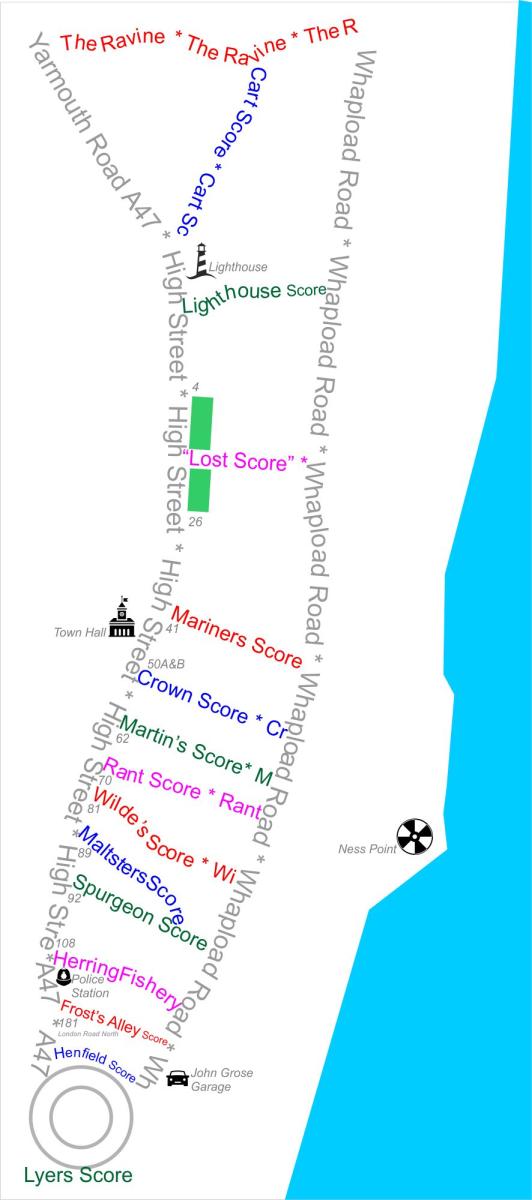
In conclusion, regarding the previous names of Lowestoft’s roads, street and scores, there remains one final track of earlier times to be mentioned. The myth of the so-called “Lost Score”, relating to the former No. 13 High Street, has been dealt with elsewhere in the LO&N History pages (see the article titled The Scores). However, Henman’s Score (which no longer exists) was referred to in No. 27 above, as having been long incorporated into the bottom end of Old Nelson Street and has to be accompanied by another track just to the south of it. Lyers Score manifests itself occasionally in manorial court records and seems to have run from the easternmost extremity of the South Field (one of the parish’s late medieval three common fields used for agriculture) down to the beach area - passing between two of the six houses referred to in the information, in No. 1, for Battery Green Road. It would have been more or less in line with the middle of the row of former Coastguard Cottages, situated at the eastern end of Gordon Road and not far from the traffic roundabout where Battery Green Road, Gordon Road, Old Nelson Street and Whapload Road all meet. With specific regard to the local topography, the slope of the land from west to east at this point would probably have been even less than that of Henfield Score – with both of them not being remotely comparable with the gradients of the cliff-face negotiated by all the others. No guesses can be made as to the origins of the name Lyers.
An annual perambulation
Once a year, the two Churchwardens – accompanied by other parish officials and a selected number of young boys – carried out the ancient required duty known as beating the bounds. Which entailed walking the parish boundaries and striking the markers (usually with green branches of willow or birch, carried by the boys) to establish both legal authority and parochial rights. In Lowestoft’s case, these markers were large beach-flints or pieces of masonry known as butts (spaced at regular intervals) which were lime-washed for visibility and had to be regularly maintained – though this was not always done and cases of neglect are to be found recorded in the annual manorial Leet Court’s proceedings, with the Churchwardens of the time being fined for dereliction of duty. This being particularly noticeable during the late 16th century and first three decades of the 17th. The long boundary with Gunton became known as The Procession Way because of the nature of this annual inspection and assertion of parochial rights, which took place at Rogationtide. This being the final week of the Easter season, with Rogation Sunday falling five weeks after Easter Sunday itself. The act of beating the bounds was able to be conducted on this particular day; on the Monday, Tuesday or Wednesday following; and even on the Thursday (Ascension Day). The word rogation derived from the Latin verb rogare, meaning “to ask” or “to request” and prayers were often made during the ritual perambulation for a fruitful harvest in the late summer or early autumn. A number of English parishes still carry out this annual assertion of parochial rights as a heritage activity.
United Kingdom
Add new comment